Aluminium strips are widely used in construction, automotive, packaging, electrical systems, and industrial manufacturing. Their combination of lightweight properties, corrosion resistance, and excellent formability makes them one of the most versatile aluminium products in modern industry.
Below is a step-by-step explanation of how aluminium strips are produced from raw material to finished product.
1. Raw Material Selection
The production process begins with high-quality aluminium ingots or billets. These raw materials are carefully selected based on purity and alloy composition. Common alloys used for aluminium strips include:
- 1xxx series (high purity aluminium)
- 3xxx series (manganese alloy)
- 5xxx series (magnesium alloy)
- 6xxx series (magnesium + silicon alloy)
The choice of alloy determines the final strength, flexibility, and application of the strip.
2. Melting and Alloying
The aluminium ingots are melted in a furnace at temperatures around 660°C. During this stage, alloying elements are added to achieve the desired mechanical and chemical properties.
The molten aluminium is then thoroughly refined to remove impurities such as gases, oxides, and unwanted inclusions, ensuring a clean and consistent metal structure.
3. Casting into Slabs or Coils
After refining, the molten aluminium is cast into large slabs or continuous casting coils. This step forms the base material that will later be processed into thin strips.
The casting process is carefully controlled to ensure uniform grain structure and prevent defects.
4. Hot Rolling Process
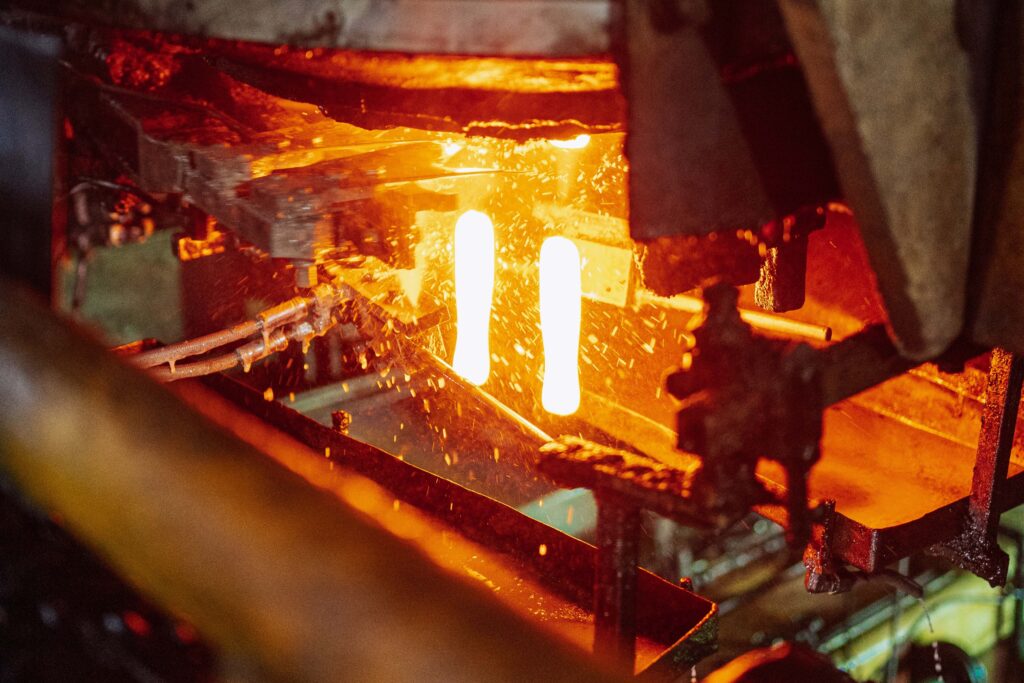
The aluminium slabs are heated and passed through rolling mills where they are gradually reduced in thickness.
This hot rolling process:
- Improves mechanical strength
- Refines grain structure
- Achieves initial thickness reduction
At this stage, the material begins to take the form of wide aluminium sheets.
5. Cold Rolling Process
After hot rolling, the aluminium is further processed through cold rolling at room temperature.
Cold rolling:
- Increases surface smoothness
- Improves dimensional accuracy
- Enhances mechanical strength
- Reduces thickness to the final strip size
This is a critical step in achieving high-precision aluminium strips.
6. Annealing (Heat Treatment)
Depending on the required temper (soft or hard condition), the aluminium strips undergo annealing.
Annealing:
- Relieves internal stress
- Improves ductility
- Enhances workability
Different tempers such as O, H14, H24, or H32 are achieved through controlled heat treatment.
7. Slitting Process
Large aluminium coils are then slit into narrower strips according to customer specifications.
The slitting process ensures:
- Accurate width control
- Clean and burr-free edges
- Custom sizing for different applications
This is where aluminium sheets become “aluminium strips.”
8. Surface Treatment
To improve performance and appearance, aluminium strips may undergo surface finishing processes such as:
- Anodizing
- Coating (PE or PVDF)
- Polishing
- Cleaning and degreasing
These treatments enhance corrosion resistance and aesthetic quality.
9. Quality Inspection
Before packaging, strict quality control checks are performed, including:
- Thickness measurement
- Width accuracy
- Surface defect inspection
- Mechanical property testing
Only qualified products are approved for shipment.